Healing Anxiety: A Guide to Inner Peace & Mindfulness
Discover practical strategies for healing and understanding anxiety. This comprehensive guide to overcoming fear and finding inner peace offers mindfulness tips and coping techniques.
Ayurovia Editior
3/4/20268 min read


Healing and Understanding Anxiety


In today's world, anxiety has become very common. However, even though it may feel like a normal part of life, it can sometimes have a significant negative impact on our daily routine. From children to elderly people, many individuals are going through this condition. If we want to protect ourselves from anxiety, we first need to understand it properly—why it happens, what effects it can have on our mind and body, and how we can manage or treat it in simple and practical ways.
In this article, we will help you understand anxiety from both the Ayurvedic and modern perspectives so that the concept becomes clear and easy to understand.
1.Understanding Anxiety: A Journey Through Ayurveda and Modern Science
a. Ayurvedic View
In Ayurveda, anxiety can be understood as Chittodvega.
Although classical Ayurvedic texts do not describe Chittodvega as a completely separate disease entity, it is considered a Manas Vikara (mental disorder). The symptoms of Chittodvega closely resemble the Purvarupa (early signs) of Unmada — a more severe mental disturbance.
If we understand the literal meaning of the word:
Chitta means the mind or consciousness
Udvega means agitation, disturbance, or restlessness
So, Chittodvega simply means "agitation of the mind" — a state where the mind experiences internal turbulence or instability.
b. Modern View
Modern medicine defines anxiety as a subjective feeling of unease, dread, or fear, often accompanied by physical symptoms such as palpitations, shortness of breath, or restlessness.
2. How Anxiety Speaks: Signs from the Mind and Body
a. The Ayurvedic View (Symptoms)
Although Chittodvega is not described separately in classical texts, its features are understood from the early signs of Unmada. These include:
Shirah Shunyata – A feeling of emptiness or lightness in the head
Ucchvasa Adhikyam – Increased or rapid breathing
Udvega – Restlessness or mental agitation
Dhyana (Disturbed Thought) – Excessive or repetitive thinking
Hrid-Graha – Tightness or constriction in the chest region
Unmattacittatvam – Inability to concentrate or an unstable mind
Ananna Abhilasha – Loss of appetite
Bhrama – Confusion or dizziness
Avipaka – Indigestion or impaired digestion
b.The Modern View (Symptoms)
From a medical perspective, anxiety activates the body's internal alarm system. Even when there is no real danger, the body behaves as if it needs to protect itself.
Physical Changes You May Notice
You might feel:
Your heart beating faster or pounding suddenly
Sweating without heat or physical activity
Slight shaking in the hands
Difficulty taking a deep, satisfying breath
Tightness or heaviness in the chest
Stiffness in the neck and shoulder muscles
Dryness in the mouth during stressful moments
These physical changes happen because the nervous system shifts into "fight or flight" mode.
Mental and Emotional Changes
Anxiety also affects thoughts and emotions. You may experience:
Constant worrying about future events
Overthinking small matters
Feeling like you might lose control in certain situations
Getting irritated easily
Difficulty sleeping because your mind will not slow down
Struggling to focus on work or studies
Avoiding places or situations that make you uncomfortable
3. How to Know If It Is Just Stress — or Anxiety?
These days, almost everyone says, "I have anxiety." It has become a very common word. But how do we know if it is truly anxiety — or just normal fear?
Feeling nervous before something important is completely natural. But anxiety is different. It does not simply go away once the situation passes.
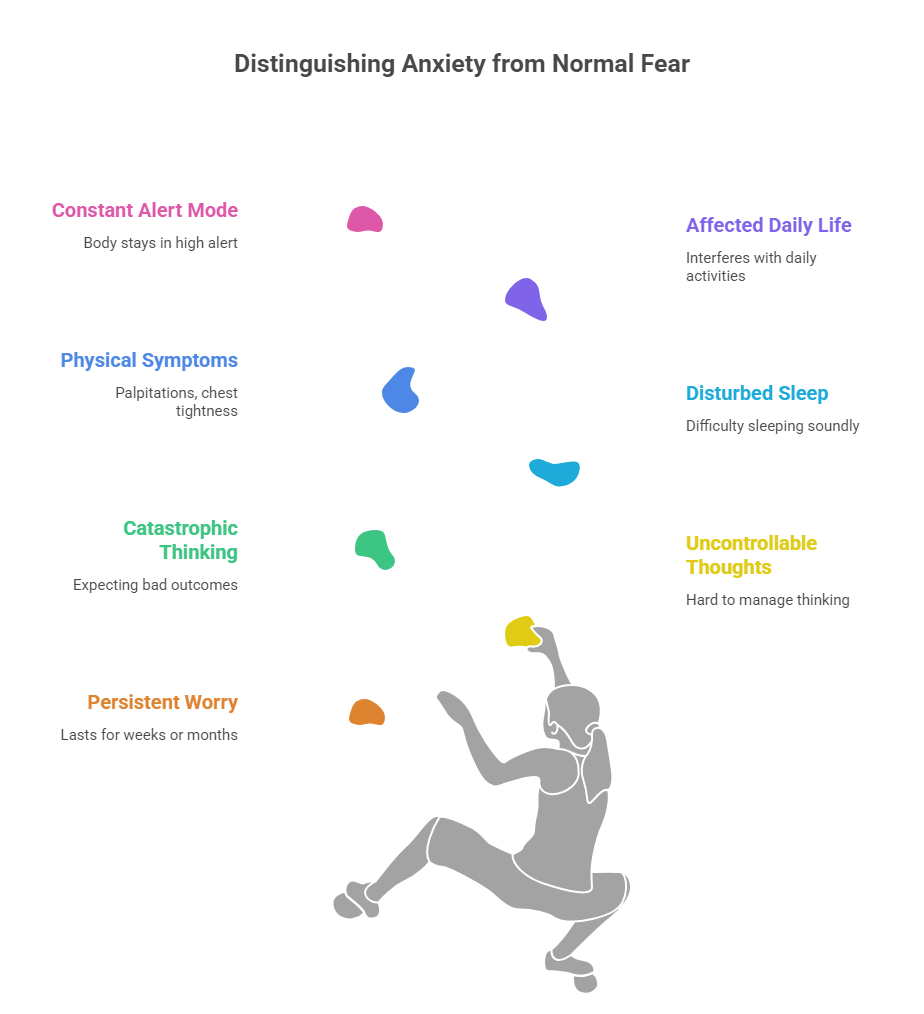
It may be anxiety when:
The worry continues for weeks or months
You find it hard to control your thoughts
Your mind keeps expecting something bad to happen
Sleep becomes disturbed
You feel physical symptoms like palpitations, chest tightness, trembling, or breathlessness
Daily life starts getting affected
One important sign is this: even when there is no real danger, your body stays in alert mode. Anxiety is not about one stressful moment—it is about a pattern that does not settle easily. Recognizing this early makes healing much easier.
4. Why Does Anxiety Begin? Exploring the Root Causes
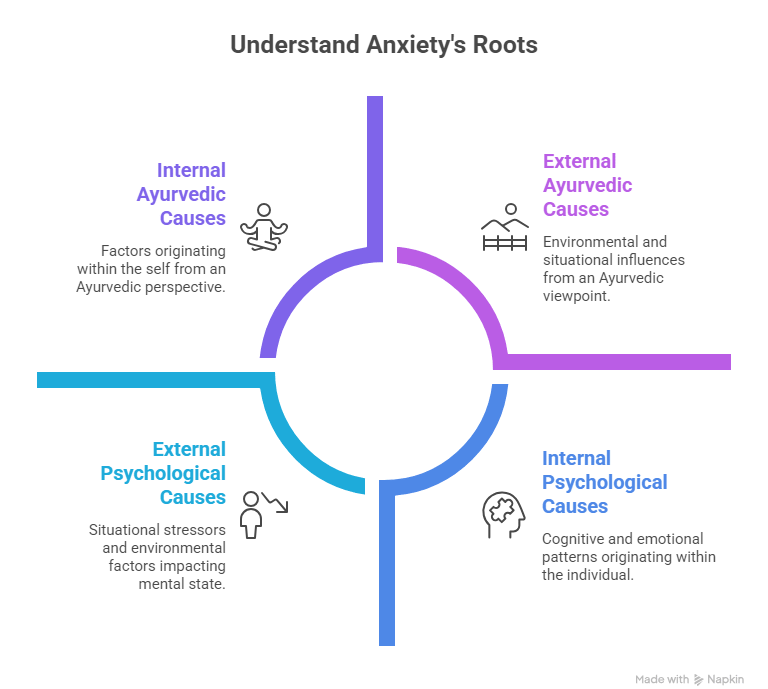
a. The Ayurvedic View
In Ayurveda, understanding the cause (Nidana) is the most important step, because Nidana Parivarjana — removing the cause — is considered the first and most powerful line of treatment.
Anxiety, or Chittodvega, does not appear suddenly. It develops gradually when our senses, lifestyle, and mind go out of balance.
1. Asatmya Indriyartha Samyoga (Improper Use of the Senses)
"Indriya" means senses, and "Asatmya" means improper or unhealthy connection. When our senses are overused, underused, or misused, mental disturbance is likely to occur.
For example:
Eyes – The natural function of the eyes is to see. But today we constantly expose them to screens — mobiles, laptops, late-night scrolling. Excess screen time strains the eyes, disturbs sleep, and overstimulates the brain. Gradually, stress increases and anxiety may develop.
Tongue – If we eat too much junk food, skip meals, overeat, or eat emotionally, digestion (Agni) becomes weak. Poor digestion affects mental stability because the gut and mind are closely connected.
Ears and Mind – Constant noise, negative news, and comparison on social media overstimulate the nervous system.
Ayurveda, therefore, emphasizes the control and moderation of the senses, because uncontrolled sensory exposure slowly disturbs mental balance
2. Prajnaparadha (Acting Against One's Own Wisdom)
This is one of the most important causes of mental disorders. Prajnaparadha means knowingly doing something that harms you. It includes:
Ignoring the need for sleep
Continuing stressful habits
Weak willpower leading to addictions
Overthinking small situations
Misinterpreting events and creating unnecessary fear
For example, if someone says something small but we repeatedly think about it and assume the worst, we create anxiety within ourselves. When discrimination (Buddhi), memory (Smriti), and willpower (Dhairya) weaken, the mind becomes unstable. In today's lifestyle, Prajnaparadha is very common — and a major contributor to anxiety.
3. Parinama (Effect of Time, Circumstances, and Change)
Parinama refers to changes caused by time and the environment. Some events are beyond our control, such as:
Loss of a loved one
Sudden life changes
Seasonal shifts
Hormonal transitions
Major new responsibilities
These are not personal mistakes—they are changes in time and circumstance. If mental strength is low or Vata is already aggravated, such situations can trigger anxiety.
Other Contributing Factors
Suppressed Emotions—Holding grief, anger, or fear inside increases inner tension.
Weak Mental Strength (Alpa Sattva)—Some individuals are naturally more sensitive and easily overwhelmed.
Agni Disturbance—Poor digestion weakens overall stability and affects the gut-mind connection.
Vata Aggravation—An irregular routine, lack of sleep, dry food, and excessive stress increase Vata, which directly relates to anxiety.
Rajas Imbalance—Excess mental activity and overthinking disturb peace of mind.
Head Injury or External Trauma – Physical or emotional shocks may also contribute.
b. The Modern View
Genetic Predisposition—Family history of anxiety or depression
Biological Factors – Increased sympathetic nervous system activity
Neurochemical Imbalance – Reduced GABA, serotonin dysregulation, noradrenaline overactivity
Cognitive and Behavioral Factors – Faulty thinking patterns, overestimation of danger
Psychoanalytic Factors – Unresolved internal conflicts
Behavioral Conditioning—Learned fear responses
Psychosocial Factors—Childhood trauma, disturbed parent-child relationships, object loss, overprotective parents, stressful life events
Hormonal and Medical Causes—Thyroid disorders, Vitamin B12 deficiency, pheochromocytoma, hyperparathyroidism
Substance or Medication Induced – Alcohol, drug use, withdrawal states, certain medications
Chronic Stress – Work pressure, financial stress, relationship stress
5. Ways to Manage Anxiety—An Ayurvedic Perspective
a. Nidana Parivarjana (Removal of Causes)
Before starting medicines, Ayurveda clearly states: "Without eliminating the causative factors (Nidana), complete recovery is not possible."
So, first we must address all possible causes that can lead to anxiety, such as:
Irregular sleep—late nights aggravate Vata
Skipping meals—this weakens Agni and increases anxiety
Excess screen exposure—which overstimulates the senses
Emotional suppression
Excess fasting or consumption of dry food
Seasonal Vata aggravation—especially in Varsha (monsoon) and Sharad (autumn)
When the cause is removed, 30–40% improvement often happens naturally.
b. Trividha Chikitsa (Threefold Treatment)
Ayurveda classifies treatment into three branches:
Daivavyapashraya
Yuktivyapashraya
Satvavajaya
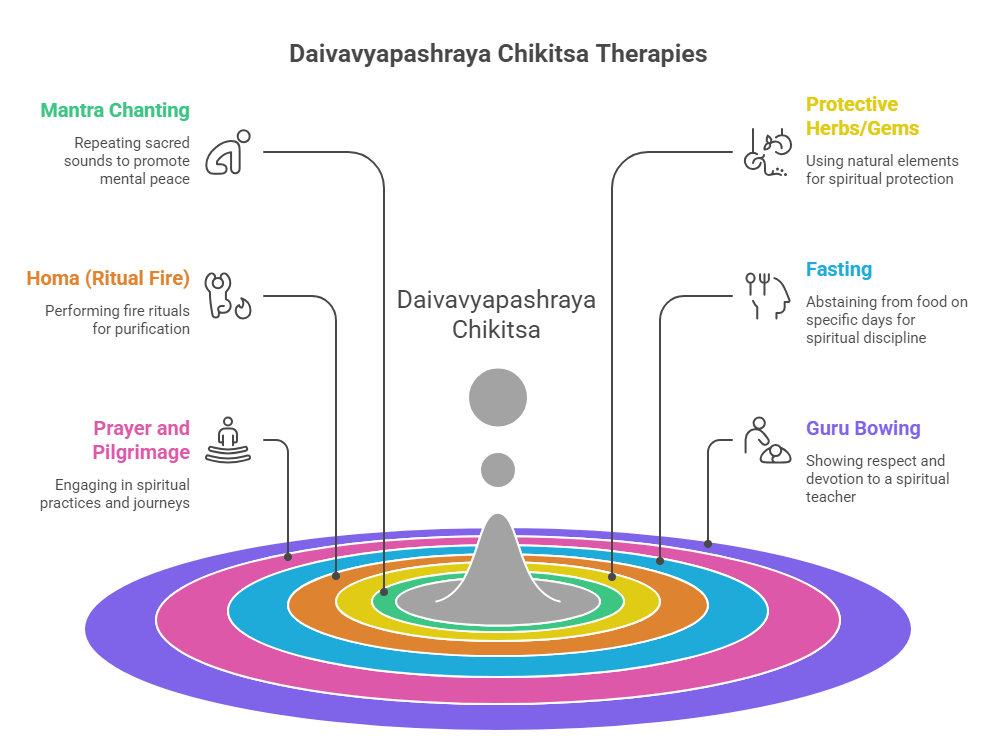
i. Daivavyapashraya Chikitsa
This includes spiritual and subtle therapies such as:
Mantra chanting
Wearing protective herbs or gems (as advised by a practitioner)
Homa (ritual fire therapy)
Fasting on specific days
Prayer and pilgrimage
Bowing to the Guru and maintaining spiritual discipline
This form of treatment stabilizes the mind through faith and surrender, reduces fear and emotional burden, and strengthens Sattva Guna. It is especially helpful when anxiety has a deep emotional or karmic background.
ii. Yuktivyapashraya Chikitsa: Rational Ayurvedic Treatment
This includes Shodhana (Purification) and Shamana (Pacification).
1. Shodhana (Purification)
Used when doshas are deeply aggravated. According to Dosha type:
Vata-dominant anxiety → Basti (main treatment). Basti directly balances Vata because the colon is the seat of Vata. When Vata is balanced, the nervous system stabilizes.
Pitta-dominant anxiety → Virechana. Removes excess Pitta that causes irritability and anger.
Kapha-dominant anxiety → Vamana (in selected cases). Removes heaviness and dullness.
Shodhana works by removing accumulated toxins (Ama) and Dosha aggravation.
2. Shamana (Pacification)
This includes internal medications and external therapies.
Internal Medications
Ghrita Preparations:
Panchagavya Ghrita
Mahapaishachika Ghrita
Kalyanaka Ghrita
Mahakalyanaka Ghrita
Ghee has lipid-soluble properties, and the brain is lipid-rich tissue. Because of this, ghrita preparations are able to cross the blood-brain barrier more effectively than many water-based substances. This allows direct nourishment of Majja Dhatu, deep action on nervous tissue, improvement in memory and emotional balance, and stabilization of Prana Vata. This is why ghrita is specially indicated in Manas Rogas — it works deeply, not superficially.
kitchen/pharmacy setting
Asava and Arishta:
Ashwagandharishta
Saraswatarishta
Dashamoolarishta
Shrikhandasava
These are naturally fermented formulations. Due to natural fermentation, they contain self-generated alcohol in small, therapeutic quantities. Alcohol enhances the bioavailability of herbal actives and allows faster absorption and better penetration — including an improved ability to influence the central nervous system. That is why Asava-Arishta are often preferred in nervous disorders. They act faster than decoctions, improve digestion, strengthen nervous tissue, and reduce fatigue and stress.
Medhya Rasayana (Brain Tonics):
Guduchi
Mandukaparni
Shankhapushpi
Yashtimadhu
Jyotishmati
Brahmi
Ashwagandha
Vacha
Tulsi
These herbs nourish brain tissue, improve concentration, reduce cortisol, calm racing thoughts, and build Ojas. They work gradually but sustainably.
Rasayana and Avaleha:
Brahma Rasayana
Kushmanda Avaleha
These improve longevity, enhance emotional resilience, and help prevent relapse.
Ras Aushadhi (Strictly Under Supervision):
Brihad Kasturi Bhairava Ras
Rasaraj Ras
Smriti Sagar Ras
Chintamani Chaturmukh Ras
Unmada Gajankush Ras
Unmada Gajakesari Ras
These are powerful mineral preparations that act deeply on the nervous system and are used in severe mental disturbances. They must only be prescribed by an experienced physician.
External Therapies (Bahya Parimarjana):
Nasya
Abhyanga
Swedana
Shiro Abhyanga
Shirodhara
Shiro Pichu
Shiro Basti
Udvartana
Parisheka
Avagaha
External oil therapies calm Prana Vata directly. Shirodhara, in particular — the continuous flow of warm oil over the forehead—relaxes the limbic system (the emotional brain) and reduces hyperactivity of stress pathways. Many patients report an immediate calming effect.
iii. Satvavajaya Chikitsa
Satvavajaya refers to the control of the mind from unwholesome influences. It is the Ayurvedic form of psychotherapy and includes:
Knowledge (Jnana)
Wisdom (Vijnana)
Patience (Dhairya)
Memory strengthening (Smriti)
Meditation (Samadhi)
Self-discipline
Positive thinking training
Emotional awareness
This branch of treatment strengthens Sattva and reduces Rajas and Tamas. In today's world, meditation is especially essential. Along with meditation, yoga and pranayama are also very helpful in calming and relaxing the mind.
iv. Prevention Measures
Ayurveda places great emphasis on prevention:
Sadvritta—Good conduct improves mental purity.
Achar Rasayana—Practicing truthfulness, non-violence, and calmness increases longevity and mental stability.
Dharaniya Vega—Controlling greed, fear, and grief. Uncontrolled emotions increase mental conflict.
Modern Treatment of Anxiety
1. Therapy (CBT)
Cognitive Behavioral Therapy (CBT) helps identify and change negative thought patterns. It teaches practical coping skills and gradually reduces the fear response.
2. Medications (If Needed)
Doctors may prescribe medicines such as SSRIs to balance brain chemicals like serotonin. These help reduce excessive worry and calm the nervous system.
3. Lifestyle Advice
Regular exercise, proper sleep, and reducing caffeine are commonly recommended to support recovery. If anxiety is severe or affecting daily life, please consult a qualified doctor.
6. A Gentle Reminder for You
Even though anxiety is very common today, in many cases we can manage it to a great extent on our own.
Start with the basics:
Maintain a proper daily routine
Sleep on time and wake up on time
Focus on a healthy diet and a healthy gut
Keep yourself engaged in meaningful activities
Practice yoga and pranayama regularly
And most importantly — meditate
These simple but powerful steps can significantly improve your mental balance, even from the comfort of your home.
However, if you feel that your symptoms are becoming intense or difficult to handle, do not hesitate to consult a qualified doctor. Proper medical guidance and treatment can make recovery smoother and safer.
Stay positive
Take care of your mind the same way you take care of your body.
Remember—anxiety can be managed, and you can move beyond it
Disclaimer: This blog is intended for educational purposes only. For treatment, guidance, or mentorship, please consult a qualified Ayurveda doctor.