About Curd in Ayurveda: Scientific Truth Beyond Common Myths
Discover the ancient Ayurvedic wisdom about curd (yogurt) - when it heals, when it harms, and how to consume it correctly for optimal health. Evidence-based insights from classical texts.
Ayurovia Editior
1/20/20265 min read


Definition of Curd?
Curd is a probiotic-rich fermented dairy food made by adding beneficial bacteria to milk. In both modern nutrition and Ayurveda, curd is valued for improving digestion, strengthening gut microbiota, boosting immunity, and supporting bone health due to its calcium, protein, and vitamin B content. When consumed properly, it promotes overall digestive balance and nutrient absorption. Curd in Ayurveda: Understanding Curd Through Ancient Wisdom
For thousands of years, Ayurveda has treated curd not as a simple dairy product but as a potent medicinal food with specific effects on the human body. While modern dietary advice often presents conflicting information about when and how to eat yogurt, ancient Ayurvedic texts provide clear, time-tested guidelines that align surprisingly well with contemporary nutritional science.
The Ayurvedic Classification of Curd: More Than Just Food
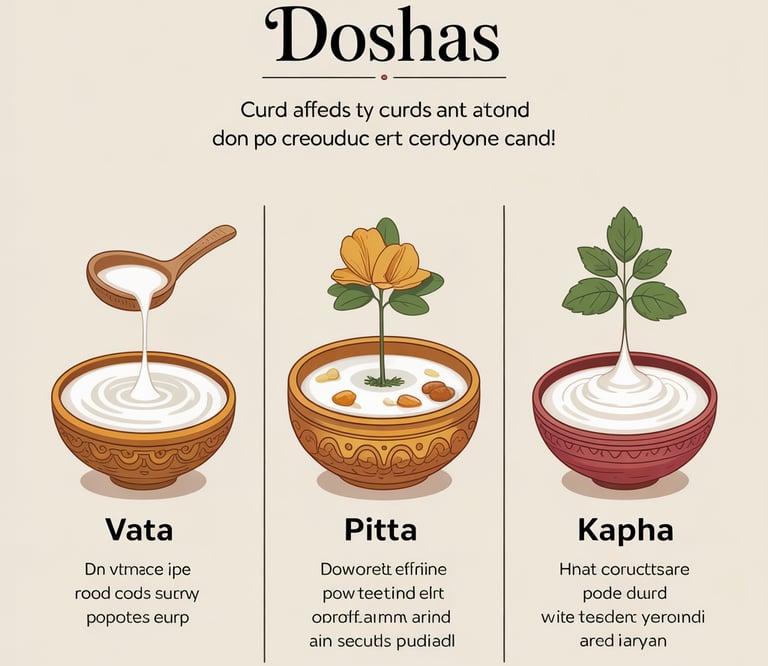
According to classical Ayurvedic texts like Ashtanga Hridaya, curd possesses distinct properties that influence bodily functions. It has a sour taste (Amla rasa), heating potency (Ushna virya), and heavy, binding qualities (Guru and Grahi guna). These characteristics make curd a powerful substance that balances Vata dosha while potentially increasing Kapha and Pitta when consumed improperly. Curd strengthens digestive fire, nourishes reproductive and fat tissues, and stimulates appetite. However, its heavy nature requires thoughtful consumption to prevent digestive burden.
When Curd Becomes Medicine: Classical Therapeutic Uses
Ancient Ayurvedic physician Bhavaprakasha documented specific medicinal applications of curd. One notable verse describes its use for chronic cold and sinus disorders, recommending curd combined with black pepper and jaggery for symptom relief. This demonstrates that curd transforms into therapeutic medicine when combined with complementary ingredients.
Ayurvedic texts recommend curd for chronic respiratory conditions, loss of appetite, fever caused by cold exposure, urinary difficulties, and certain digestive disorders when using fat-removed preparations. These applications reveal that curd's medicinal value depends entirely on proper preparation, combination, and timing.
The Intelligent Way to Consume Curd: Ayurvedic Guidelines
Ayurvedic wisdom emphasizes that no food is universally good or bad—the method of consumption determines the outcome. For example, proper eating practices include pairing it with ghee to balance its heating properties, mixing it with honey or rock sugar for enhanced digestion, or consuming it alongside moong dal for protein balance. Quality matters tremendously: use only fresh, properly fermented curd; avoid overheated or reheated preparations; and consume in moderate quantities rather than making it a daily staple. These combinations create synergy, allowing curd's benefits to manifest while preventing potential imbalances. Ayurveda teaches us to eat curd with intelligence, not assumption.






The Hidden Dangers: When Curd Creates Disease
Classical texts, including Charaka Samhita and Ashtanga Hridaya, warn that improper curd consumption can trigger various health conditions. Daily consumption without seasonal consideration, eating overheated or excessively sour curd, consuming improperly fermented products, or eating without balancing complementary foods can lead to fever, inflammatory conditions, bleeding disorders, skin diseases, anemia-like conditions, and mental fog with physical heaviness. These warnings highlight why Ayurveda treats curd as a powerful substance requiring respect and understanding rather than casual consumption.
Night-Time Curd Consumption: Debunking the Cold Myth
One of the most widespread beliefs about curd is that it should be avoided at night because it is cold. This represents a fundamental misunderstanding of Ayurvedic principles. Curd actually has heating potency, not cooling properties. Its heavy quality makes it difficult to digest, and since digestive capacity naturally decreases during evening hours, heavy foods consumed at night increase Kapha dosha. When eaten at night, curd's heaviness overwhelms weakened digestive fire, leading to excessive mucus production, sinus and respiratory congestion, incomplete digestion, and morning sluggishness. The restriction on nighttime curd consumption stems from digestive wisdom, not temperature misconceptions.
Seasonal Intelligence: Eating With Nature's Rhythm
Ayurvedic masters Charaka and Vagbhata emphasized aligning food choices with seasonal variations. This principle applies strongly to curd consumption. Winter months naturally support curd digestion because of stronger digestive fire in cold weather, the body's need for nourishing heavy foods, and heating potency that balances external cold. Conversely, summer months make curd problematic because of already elevated internal heat, risk of excessive Pitta aggravation, and potential digestive disturbance.
Modern Nutritional Science Validates Ancient Wisdom
Contemporary research on fermented dairy products reveals insights that complement Ayurvedic understanding. Science confirms that curd contains beneficial probiotic bacteria supporting gut health, provides high-quality protein and calcium, has partially broken-down lactose through fermentation, digests slowly, particularly during reduced metabolic periods, and may worsen mucus production in people with respiratory sensitivities. Fresh, hygienically prepared curd offers maximum benefits, while over-fermented or contaminated curd irritates the digestive lining.
Modern science explains the biochemical mechanisms behind what Ayurveda observed through empirical practice thousands of years ago. When we examine both perspectives, a unified truth emerges: food quality cannot be judged in isolation—timing, quantity, seasonal context, and individual digestive capacity determine whether any food becomes nourishment or a burden.
Practical Takeaways for Healthy Curd Consumption
Curd represents a powerful food capable of both healing and harming, depending on usage. Consume curd primarily during cold seasons, combine it with balancing ingredients like ghee or honey, choose fresh, properly fermented varieties, eat it in moderation rather than daily, and consider your individual digestive strength. Avoid eating curd at night when digestion weakens, during hot weather or summer months, using overheated or stale preparations, eating it in large quantities without complementary foods, or ignoring personal sensitivities.
Conclusion: Food Wisdom Beyond Fear and Fashion
Ayurveda does not promote food restriction based on fear but encourages intelligent awareness about how different substances interact with our unique physiology and environment. Curd exemplifies this principle perfectly—when consumed with understanding of its properties, proper combinations, appropriate timing, and seasonal suitability, it becomes nourishing medicine. When eaten carelessly, it creates imbalance and disease.
The ancient physicians who codified these guidelines spent lifetimes observing how foods affect human health across different conditions. Their wisdom, now increasingly validated by modern research, offers us a practical path beyond dietary confusion. Eat curd with awareness and intelligence, not assumption or blind tradition. Let both ancient wisdom and personal observation guide your choices.
To learn more about curd in detail, click the link below to read the complete guide on curd in Ayurveda.
Keywords: Ayurveda curd benefits, yogurt in Ayurveda, Ayurvedic diet guidelines, when to eat curd, curd night consumption, seasonal eating Ayurveda, dosha balancing foods, fermented foods Ayurveda, traditional Indian medicine, digestive health Ayurveda